

Film version of Sandy’s memoir, Hello Darkness, My Old Friend, on track for 2027 release. Click here for more.
FROM HELLO DARKNESS · YOUNG READER EDITION
Chapter One · By Sanford D. Greenberg
Have you ever had a dream that you dreamed many times? Not every night, but maybe a few times a year? This happened to me a long time ago when I was a boy. The dream was not a happy one, but it’s important to my story, so I’ll tell it to you.
In the dream it is a sunny late-summer day at Crystal Beach in Canada, just west of Buffalo, New York. A tall, handsome father in a bathing suit is carrying his five-year-old son on his back about twenty yards from shore out into Lake Erie. Both are laughing as the father runs through the waves. The father playfully lowers himself and his son into the lake, and as the water slaps at the child’s bathing suit, the boy begins to tremble and laugh. Danger excites him; he has never been out in the water before. But in his father’s arms he is safe.
Suddenly, the father, still holding the boy, turns and pushes through the water toward the shore. The boy is surprised and at first amused. At the shoreline, the father hesitates for an instant. Then he slams facedown on the hard, wet sand, forcing the boy’s face into it. The boy rolls his father over and sees his glazed and vacant eyes. The father is dead. The boy sits and stares blankly.
The reason for this dream is clear. In 1946, I went on my first trip to the beach. Later that same year, my father died. The beach trip was an important early memory, but soon after, a bigger event happened—the death of my father—and my dream mixed the two together.
My father, Albert Greenberg, was a tailor who had to work long, hard hours to provide for his family. He had very little time left over to spend with his children. I admired him, but since he died when I was five years old, I don’t have many memories of him.
I remember his last morning. My little brother, Joel, and I walked him to the streetcar stop and waved goodbye as he left for work. We found out later that at lunchtime he walked to the corner pharmacy, where he collapsed and died. I never knew exactly what he died of. Probably a heart attack from years of stress. Albert grew up in a small village in Poland, in Eastern Europe. He was Jewish, and this was a very bad time to be Jewish in Eastern Europe. Because times were hard, people often took their frustrations out on Jewish people, smashing up their shops and homes and making life miserable for them.
In 1934, Albert, as a young man, moved with his family to Cologne, Germany. Cologne was a city of culture and refinement, so they thought it would be a better place for a Jewish family. Boy were they wrong!
The Nazis had just come to power in Germany. They began rounding up Jewish people and sending them to concentration camps, where they were forced to work as slaves. Many died or were killed. Albert and a group of his family and friends made it out of Germany just in time. They spent many months wandering about Europe, walking from place to place, knocking on doors, looking for shelter. They were lucky to find people kind and brave enough to help them. Finally, in 1939, almost two years before I was born, they made it to Paris, France. But the Nazis were not far behind. My father and the others migrated to the United States just before the Nazis invaded France.
He settled in Buffalo, New York, where he was free to earn a living without being persecuted for being Jewish. But he never lost the habit of looking over his shoulder for danger. The stress finally caught up to him that day inside the pharmacy in Buffalo.
That evening, his coffin lay in the center of our living room in Buffalo, draped with a black velvet cloth embroidered with a Star of David. I thought the cloth was keeping him warm. Remember, I was five years old. I knew he was dead, but I didn’t really know what that meant. Candles representing the divine spark in the human body burned in red glass containers. I touched the coffin with my fingers, playing on it as if it were a piano. I sat under it like a good boy. I fiddled with the loose stitching of the cloth that hung below the bottom of the casket. I knew it was a terrible occasion, though I did not know precisely why. I was frightened and confused.
Then came the burial. It was a bleak, gray day. Wind swept across the cemetery. We huddled together like peasants. I stood among the adults at the burial site, unable to make sense of the silent scene—as perhaps no five-year-old could. The mounds of dirt surrounded a large rectangular hole in the earth. The coffin rested to one side. Amid the sobs of those gathered around me, the rabbi began chanting a prayer. We put my father in the ground. The coffin was lowered on worn leather straps until it was nearly at the bottom. There were only a few inches between him and the cold ground, but in my mind he wasn’t quite buried yet. And so that meant maybe he wasn’t really dead. We could open the coffin. He could come out. Climb out of the hole, come home, and shower. Have lunch, live a good, long life.
Then the straps suspending the coffin were unhooked and whipped out. Next came something worse. Those who volunteered were each handed a shovel, and they took turns throwing soil onto the coffin. I know now that this act is thought by Jewish people to be a mitzvah, a good deed. But at the time it felt the opposite. I had a strong urge to jump into the hole to rescue my father. Yet I stood motionless as each new shovelful of earth landed on top of the coffin with a thud.
My father’s death changed my world. I was now the man of the family—something I recall comprehending even at that young age. I felt responsible for my mother and my little brother and sister. My father had been the head of the family, but now we were down to four and I was the oldest male.
I was sad, but I also remember feeling an uncomfortable sense of freedom. I know that sounds strange, but it’s true. I’m old now, so I want to tell you only what I know to be true. I clearly recall feeling free. Not triumphant or joyful, just free in a new way. Yes, there was a wretched feeling of loss that has stayed vivid in my memory, but blessedly, there was a new feeling opening up in me. It was a little scary, because I didn’t really understand it. I realized after my father’s death that I no longer had the same limits and restraints. That realization was an “epiphany.” I’ve had many epiphanies in my life, times when things suddenly come together in my mind in a new way. They’re kind of thrilling. I’ll tell you about some others later on.
Anyway, some years later I read a passage in the Bible, in which God commanded Abraham to “go forth.” He also told Abraham to leave everything behind. I remembered comparing Abraham’s situation with mine. Abraham had a specific destination. I didn’t. I had to stay in Buffalo and grow up and be a good son and help take care of my brother and sister. After that, I didn’t know where I was supposed to go, but I knew one thing—I wouldn’t have to leave everything behind. My family and friends would always be there with me.
This knowledge has made all the difference in my survival. When I was a young man in college, I went blind. That’s a lot of what this story is about. But not completely. What happened after I went blind is much more important. But before I get into that, I need to tell you about the things that happened between my father’s death and my loss of sight. The reason I told you about my father’s death is that it taught me something big: if I could handle that, I could handle just about anything.
Discover the complete story in the young-reader edition of Hello Darkness, and follow Sandy’s remarkable journey through loss, friendship, courage, and determination.
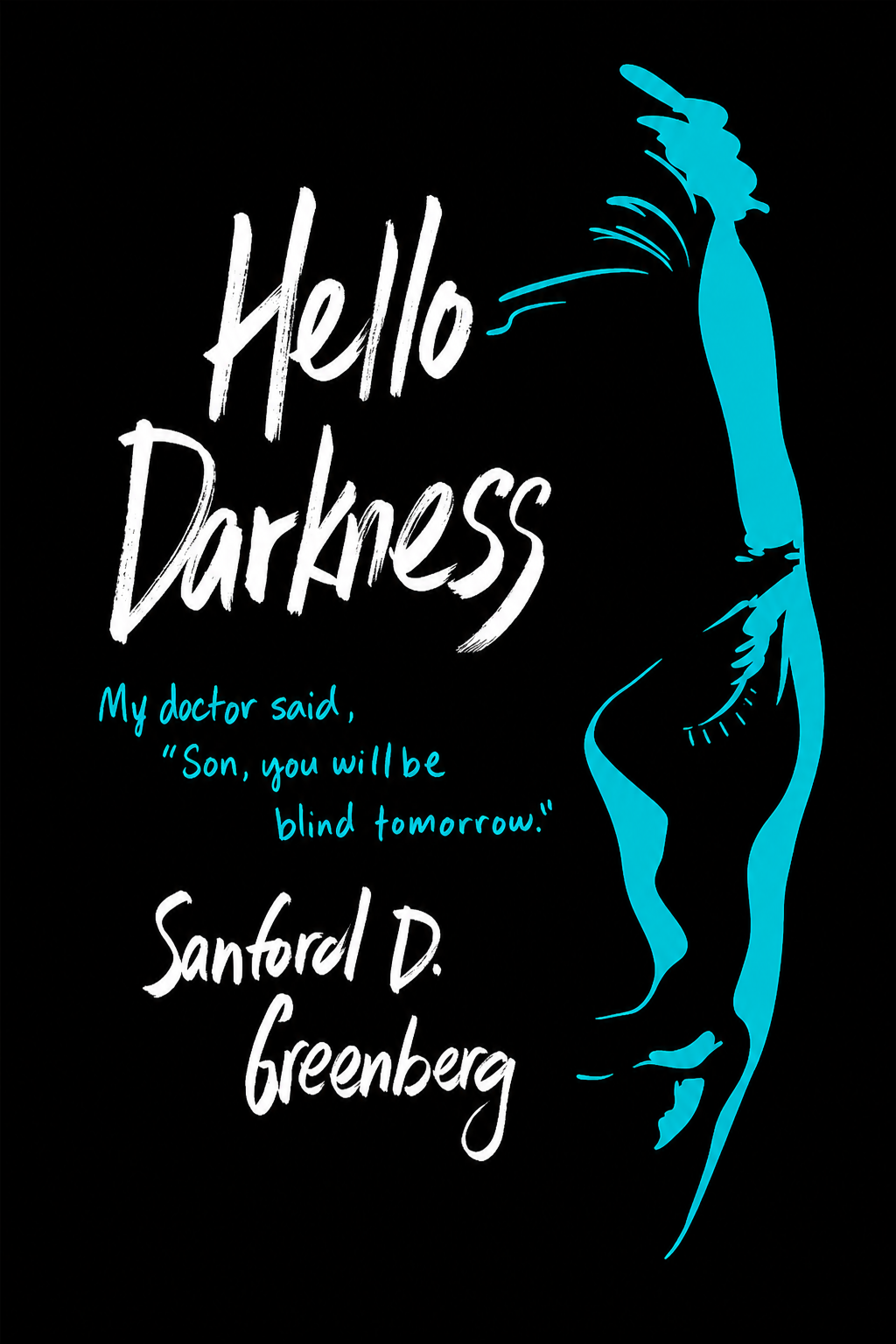
“You would think that a book about a young man going blind would be very sad. I went blind at age nineteen, and, yes, there were some awfully hard times. But my story is more than a tragedy. In fact, it’s not really a tragedy at all.”